
New qualitative research undertaken by COTA SA (Council on the Ageing) and funded by The Wyatt Trust has highlighted the challenges facing many older South Australians as the cost-of-living crisis continues.
Beyond financial pressures, many people aged 50+ are contending with the compounding effects of low income, social isolation and compromised health.
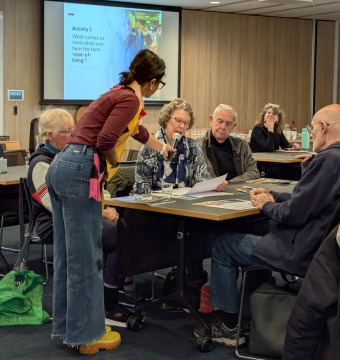
The research spanned in-person and online workshops, phone and video interviews during which participants shared their personal experiences of trying to make ends meet. The need for help to navigate the system to find the right support services and concessions was a key finding from the research.
“As a peak body and advocate, COTA SA’s challenge is to identify the specific changes that would make a difference to people’s lives and then act on them,” explains COTA SA Chief Executive, Miranda Starke.
“Through this work, we gained deep insights into the lived experience of hardship among older people, enabling us to shape a fit-for-purpose solution ready for funding and implementation. As a result of this project and in the lead-up to the 2026 State Election, COTA SA is advocating for the establishment of a Life Navigation Service for people aged 50+.”
The Navigation Service, which is designed by, with and for older South Australians, will connect people with “practical help, advice and service referrals, supporting them to make informed decisions and avoid crisis points through early intervention and guided navigation,” Miranda says, adding that “COTA SA is actively seeking program funding and partnerships to bring this program to life for older South Australians.”
Challenges for the ‘missing middle’ and pensioners experiencing cost-of-living pressures
The research, led by Sharmilla Zaluski from COTA SA’s market insights social enterprise, The Plug-in, also found pronounced differences between age groups.
“These systems are challenging to navigate at the best of times, and even harder when you’re experiencing significant stress,” Sharmilla explains.
In terms of compounding stress, people aged 50-65 have become the ‘missing middle’ – a cohort not yet eligible for the aged pension who are dealing with a range of pressures including ageism which is impacting employment opportunities and their ability to afford housing. Some have had time out of the workforce caring for family members or dealing with health issues resulting in reduced superannuation.
“Some people in this group shared with us that they’re not eligible to receive NDIS funding and not old enough to receive the pension and the additional supports that opens up, so they’re really struggling with significant physical and mental health impacts,” Sharmilla explains.
“And then for people of pension age, 67+, particularly those on a full pension, the ability to influence or change their income stream is
very limited.”
“Age Pensioners told us there is little money available to get through a fortnight after paying mortgages, rent, and utilities. Some
Pensioners are relying on the Home Equity Access Scheme to top up their pensions, and fear what will happen when that runs out.
“When there are competing financial pressures, health and social needs tend to take a backseat. This means things like dental appointments, car servicing, home repairs and sometimes even heating and cooling become unaffordable for many older people.”
The importance of design led by lived experience
 A
sense of isolation was another theme that negatively impacted both the ‘missing middle’ and pension aged groups. Isolation took many forms
including social isolation, physical distance from services for people living away from the city, and the isolation experienced by those
who do not have English as a first language.
A
sense of isolation was another theme that negatively impacted both the ‘missing middle’ and pension aged groups. Isolation took many forms
including social isolation, physical distance from services for people living away from the city, and the isolation experienced by those
who do not have English as a first language.
“What we heard across both age groups was that social connections and social activities like clubs and memberships are the first things to go with cost-of-living pressures,” Sharmilla explains. “This has such a detrimental impact on health and longevity.”
“We also found that if it's hard for people with English as a first language to find and navigate the supports that might be available to them, it is highly challenging for people who don't have English as a first language and have to rely on translators.”
Thirty-five per cent of research participants voluntarily reported that they were survivors of domestic and family violence, which brought additional complexities.
“These past traumatic events need to be considered because there are so many impacts years down the track in terms of vulnerabilities and support needs,” Sharmilla explains.
It’s also one of the reasons why valuing the voices of lived experience in the co-design process has been so powerful, she says.
“The process of hearing what the issues are, workshopping them, asking what the supports would look like and then being able to go back to the group and keep working through ideas and solutions where this program could make the most difference to their lives,” Sharmilla says.
“The whole time we’re co-designing to come up with the best supports and the best service together.”
Read The Plug-in’s full report and lived experience insights
Connect with COTA SA to learn more about the Cost-of-Living Navigation Program: cotasa@cotasa.org.au
Images courtesy of COTA SA
